Blog Post 11- A Nightmare on Elm Street II: Freddy’s Revenge


Summary:

In Harry M. Benshoff’s article “The Monster and the Homosexual”, Benshoff discusses the relationship between the homosexual and the monster. According to Benshoff, the concept of “homosexuals” and “monster” arouse many of the same fears in people about sex and death. This was especially true in the time of the AIDS crisis. Viewed similar to vampires in a horror film, gay men where seen as contagious and with single mingling of blood, a pure innocent person became victim to this disease just as with vampires, the person would become the undead. According to Robin Wood, monsters can be viewed as racial, ethnic, and/or political/ideological Others or as sexual Others (women, bisexuals, and homosexuals). The term “queer” is discussed and identified as what someone who doesn’t explicitly define themselves in a “traditional” homosexual term. The queer, according to a theorist, “revels in the discourse of the loathsome, the outcast, the idiomatically proscribed position of same-sex desire.” Further into the article, Benshoff discusses the role reversal involving homosexual characters. A gay male normally takes on more of a feminine side where as a lesbian character typically becomes more masculine. This idea is similar to the idea of phallicization from Carol Clover’s article. There are four ways that homosexuality might intersect with the horror film. The first is when horror films contain identifiably gay and/or lesbian characters. The second is a horror film that is written, produced, or directed by a gay man or lesbian. The third is through subtextual or connotative avenues. The fourth is through the sense that any film viewed by gay or lesbian spectators might be considered queer, so through the audience.

Analysis:

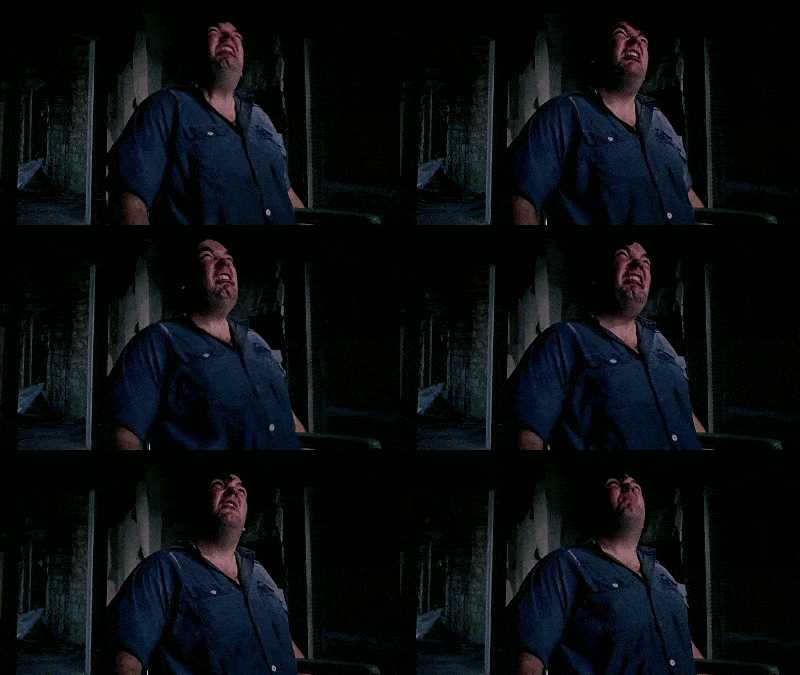
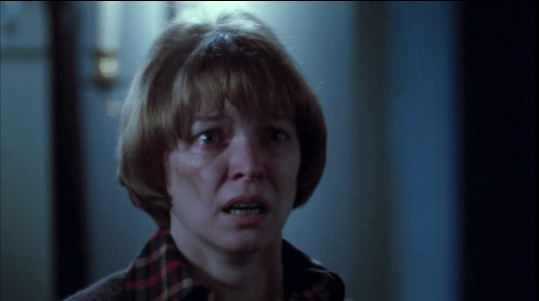
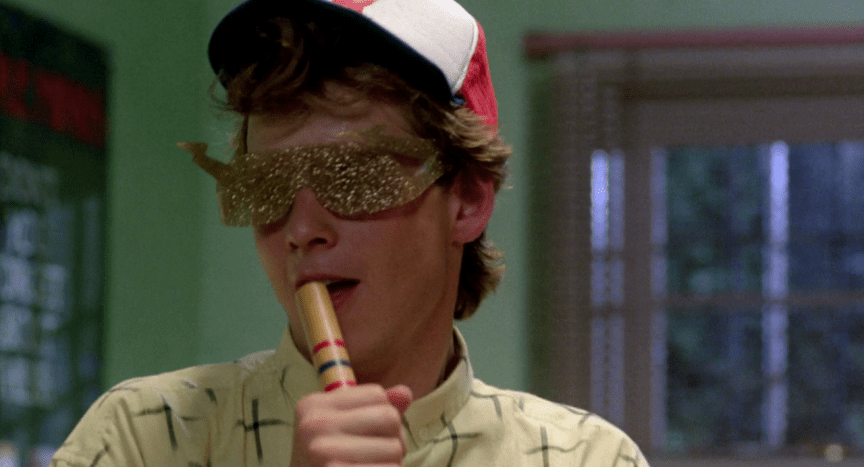
In Jack Sholder’s A Nightmare on Elm Street 2: Freddy’s Revenge, the audience sees homosexuality intersect with the horror genre through a subtext avenue (Benshoff’s article) and stereotypical homosexual male traits. The homosexual subtext in this film suggests that the main character, Jesse struggles with his sexuality even though the audience sees him in a heterosexual relationship with Lisa. The audience sees Jesse’s feminine nature in many scenes. For example, in the scene where Jesse is unpacking his bedroom after he’s moved on Elm Street. As he starts to “clean” and “unpack” he puts on a tape of girly music, puts on some glittery sunglasses, and dances around his bedroom until Lisa comes over and interrupts him. The audience also sees his feminine side when Jesse and Freddy meet face to face. Jesse becomes terrified and screams in a high-pitched girl-like way.
Source: New Line Cinema

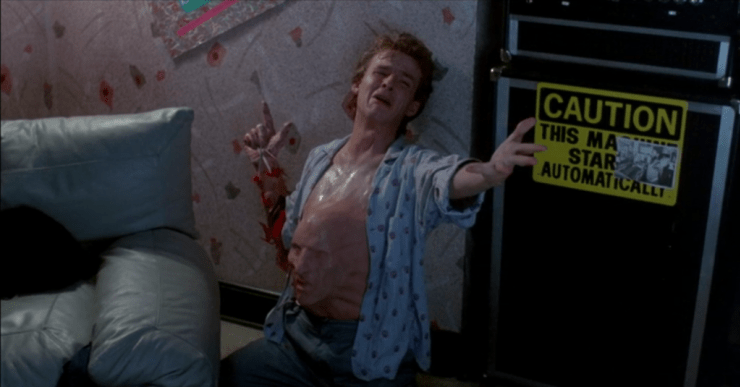
The audience sees Jesse’s repressed sexuality emerge when Freddy is “inside” of him. At Lisa’s party, when Jesse and Lisa are being intimate, a creepy, long, purple tongue comes from Jesse’s mouth and licks Lisa. This is Freddy’s way of trying to block Jesse’s heterosexual relationship with Lisa and get inside Jesse (Benshoff’s article). Jesse quickly gets up and runs away. After not being able to perform sexually with a female because of Freddy, he seeks comfort and help from his male best friend. Later in this scene, as Freddy is taking over Jesse’s body and attacking Ron, the film shows Freddy physically “coming out” of Jesse. This could be a symbolic “coming out” just as a homosexual person would “come out” as gay. The audience also sees the repression of Jesse’s sexuality (Benshoff’s article) when he is trying to keep Freddy from coming out and hurting Lisa. Jesse says, “There is something trying to get inside my body”, “he’s inside me” and “he wants to take me again” all while Lisa is trying to get Jesse to fight Freddy and to not let him come out. This symbolizes how some homosexual individuals may feel while coming to terms with who they are. Some may want to represses their homosexual urges but they can not.
Source: New Line Cinema

The audience sees another example of the homosexual and the monster in the sadistic gym teacher, Mr. Schnieder. In the film, it is revealed that Mr. Schnieder likes to hangout at “a queer S & M joint” and that he “likes pretty boys” which suggests he is gay. Although Mr. Schnieder is not the main monster in the film, he plays a role in making Jesse and Rons’ lives miserable during school. He forces the boys to do pushups outside until their arms are weak and wobbly. Later in the film, when Jesse leaves his house after another nightmare, he is caught drinking a beer by none other than Mr. Schnieder dressed in a promiscuous leather outfit. Schnieder then forces Jesse to run laps in the gym and then shower. As Jesse showers, a mysterious force ties Mr.Schneider up with jump ropes in the showers facing the wall, rips off his clothes, and spanks him repeatedly with a towel all while Jesse watches. Freddy Krueger then makes his first appearance in the real world and kills Schnieder with his sharp blade fingers.
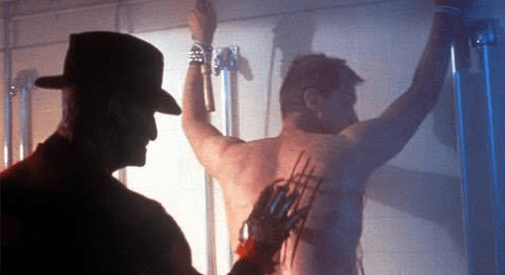
Source: New Line Cinema

Overall, this film contains many different forms of gay subtext and the monster and the homosexual while demonstrating sexual repression and horror.
Blog Post 10- Candyman

Summary:

In Robin R. Means Coleman’s article “Studying Blacks and Horror Films”  Coleman discusses the difference between “Blacks in Horror Films” and “Black Horror Films” as well as horror as a genre. Coleman discusses a book by Isabel Pinedo and how she defines the horror genre. According to Pinedo there are five key descriptors: (1) horror disrupts the everyday world; (2) it transgresses and violates boundaries; (3) it upsets the validity of rationality; (4) it resists narrative closure; (5) it works to evoke fear. Another characteristic of the horror genre is that they are normally very complex. “Blacks in horror” films present Blacks/Blackness in the context of horror and understanding how Blackness is represented. The “racial other” is also incorporated into these films. “Black Horror films”, on the other hand, present Black experiences and cultural traditions. It is said that “black horror films” generally have a black writer, producer, director, actors because these people are able to better reach the black audiences and relate to their lives. Depending on the film, the black characters could be there to solely become a victim, others create a character and some are portrayed as horrific, monstrous killers. In the section titled, “A Century of Black Horror” the author discusses the evolution of Black Horror from before the 1930’s until the 2000’s. Black horror has gone from comedy shorts for the amusement of the non-black audiences to films inspired by hip-hop culture and that present a spatial allegiance to “the hood” just as the “black horror” films in the 1990’s.

 Analysis:

Bernard Rose’s Candyman (1992) is a film that presents ideas that black characters can be the thing that horrifies and the victim that is horrified. Throughout the film, the audience sees the black characters as both the victims of terror and the terrorizer (Coleman’s article), but the audience also sees a horrifier as a young white woman, Helen. Anne-marie is a single mother that lives in Cabrini-green and she is “terrified of what could happen” after hearing Ruthie Jean screaming as she was being attacked by the Candyman. One could argue that the Candyman himself is a character that is horrified and a horrifier all in one. When the Candyman was alive, he fell in love with a young white woman. He had impregnated her and the girl’s father ordered him to be killed. In the moments leading up to his death, he was terrified. These acts of horror that were performed on him led him to become the thing that horrifies.

Source: Universal Pictures

The audience also sees the concept of the racial other in this film. In this film, the Candyman would be considered as racial other (Coleman’s article). As the son of a slave, the Candyman was born into the class of those not seen as people but as property. As he grew up and his father made an important discovery, the Candyman was fortunate enough to be brought up properly and in an upper class home. Once grown, he discovered his love for painting. When he was asked to capture the virginal beauty of a white man’s daughter, he did so while he and the daughter fell in love. Although this relationship was two-sided, the father felt his daughter had been taken advantage of solely because the Candyman is black. This shows that although the Candyman had grown up with privilege and opportunities, the same as the white daughter, the father could not look past his skin color. This is a prime example of how the Candyman (a black man) is compared to his white counterparts and is seen as inferior.

The audience also can see the parallel between the Candyman and a demon. In Coleman’s article she says Blacks can be rendered as “a metaphor and catalyst for evil, and demonized, even though not always cast, physically, in the role of a demon.”  Just as demons, the Candyman can be summoned and is seen as an extremely evil figure.

The audience also sees the concept of racial profiling and white privilege in this film. As the film shifts from the nice, clean and light area that houses primarily white residents to the dark, dirty, and dangerous Cabrini-green. The audience sees the Candyman mainly terrorizing the people of Cabrini-green. This suggests that danger, violence and evil is primarily coming from the black residential area which parallels to racial profiling and racism.

Source: Universal Pictures

At the conclusion of the film, Helen’s husband, Trevor, is butchered by Helen in their home after he called her name five times and turned out the light. The idea that Helen has taken Candyman’s place horrifying people suggests that violence can happen anywhere and be committed by anyone, not just black people in black communities.

Blog Post 9- The Babadook

Summary:

In David Skal’s article It’s Alive, I’m Afraid, the main topic of discussion is deformities. The opening line of the article is “All monsters are expressions or symbols of some kind of birth process, however distorted or bizarre.” This quote anchors the discussion throughout the whole article. Skal discusses the arrival of birth control pills in the 1960’s. Obviously, the point of these pills is to be able to have sex without raising the chance of pregnancy. Within two years of the Pill introduction, another drug surfaced to help treat women suffering from morning sickness – Thalidomide. Thalidomide resulted in some of the most profound birth defects of that time because of its interruption of the formation of limbs, or causing brain damage or facial deformities. The results of this drug sparked America’s fascination with “freaks”. This fascination led to movies focused on horrific births and deformities such as Rosemary’s Baby. In the post-Pill period, “normal” childbirth vanished and the sole image in the public’s mind was horrific births. While some movies did not portray the horrors of birth, they did make people uneasy about future parenthood. There is a section in the article that discusses ‘dead baby’ jokes. The person telling these types of jokes are often referring to themselves (an adolescent or adult) being “dead” to childhood or being a teenager. A certain quote sparked my interest while reading this article and that quote says “Monstrous children, horrific pre-children, and abused (i.e. aborted) children became staple commodities in mass-market horror fiction in the seventies and eighties.” In my opinion this quote best summaries the ideas of the article. In the post-thalidomide time period, the public had become fascinated with different deformities and sexual/reproductive horror that focused on the “freaks” of society.

Analysis:

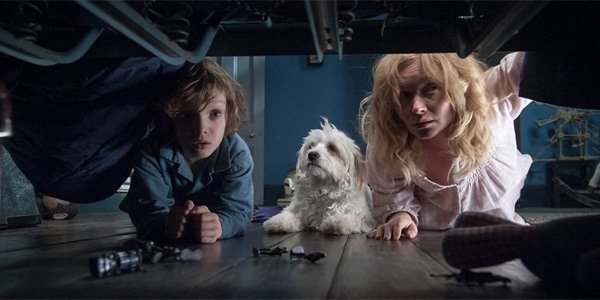
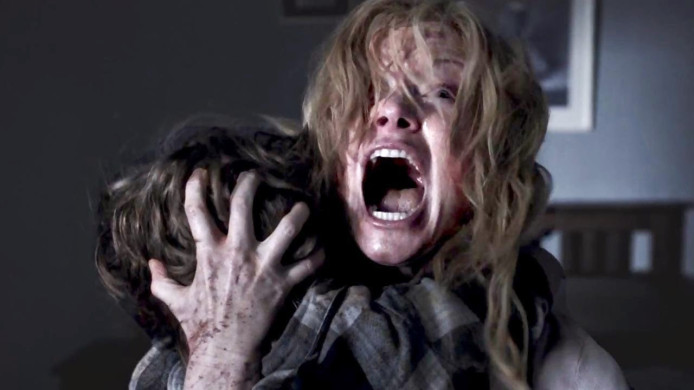
Jennifer Kent’s The Babadook (2014) is a film that demonstrates the horrors of a grief stricken mother and her son, Samuel. Throughout the film, the audience sees Amelia feel intense grief and sadness over her husband’s death. The Babadook, although a book character, is a representation of Amelia’s grief that she won’t let go of. The longer she goes denying reality and not accepting her husband’s death, the stronger the grief will grow, just as the Babadook gets stronger as you deny it. The idea that the Babadook started as a simple book character but then took form and terrorized this family closely relates to the title of David Skal’s article “It’s Alive, I’m Afraid”. As the film begins, Amelia insists that Mister Babadook is not real and there is nothing for Samuel to be afraid of. As the film goes on, the audience sees Amelia to come to the realization that this creature is very much real and is a force that she does not want to face.

Throughout the film, the audience sees the way everyone views Samuel. People see him as a deranged, violent child who needs help for a mental issue. He claims to see monsters in his bedroom at night and insists that he will “kill the monster when it comes”. People view him as a freak of society, even though he is just a little boy. Samuel is viewed in the same way some people were viewed in the 1970’s (Skal’s article). Many people in the 70’s became fascinated with “freaks” but in this case, people feared what Samuel could be capable of.

Source: IFC Midnight

Amelia essentially hates her own son because she blames his being born for being the cause of her husband’s death. Due to this hatred and resentment, a monster is formed within Amelia. In Skal’s article he says, “All monsters are expressions or symbols of some kind of birth process, however distorted or bizarre.” This quote very closely relates to the situation that Amelia faces because a monster within was created on the day her son was born. Therefore, there is a direct correlation between the birth process of Samuel and the monstrous side of Amelia. The Babadook allowed Amelia to finally unload all her true feelings she felt towards Samuel and other characters in the film (ex: the blonde mother at Ruby’s birthday party). This anger leads to Amelia essentially tearing her family apart and trying to kill Samuel. Once she is finally able to face the Babadook and contain it, she is in a way finally facing the grief and suffering that she has been living with for the past seven years. As the audience sees at the conclusion of the film, the Babadook never goes away, but is being maintained in the basement where Amelia also keeps all of her husband’s belongings. The location of the Babadook’s new home is no coincidence. Just as she faced the Babadook, Amelia was finally able to come to terms with the loss of her husband. By doing this, she has been able to manage and contain her pain just as she is doing with the Babadook.

Source: IFC Midnight

Bog Post 8- The Stepfather

Summary:

In Tony Williams’s article Trying to Survive on the Darker Side: 1980s Family Horror, Williams provides a critique of Carol Clover’s depiction of women in horror films. Clover argues against categorizing slasher films as films that display male voyeurism towards the female body. Before analyzing Clover’s view on the feminine in the horror film, Williams’ addresses the use of special effects. The rise of special effects began in the 1970’s and only grew and was more prevalent in the 1980’s horror films. Williams’ argues that females in 1980’s horror films are alive, yes, but victorious, no. For example, Friday the 13th, Part III, the Final girl is taken away, calling in agony for her boyfriend in a nonindependent way that does not support the idea that she was victorious. This is a break of the rigid mold that Clover has put in the “Final Girl” into. Williams’ moves into the role of dysfunctional families in horror films. Versions of Friday the 13th, Halloween, and Nightmare on Elm Street show the role of dysfunctional families. In horror films, we need to consider the social origins of the monsters behind the mask. The stalker/slasher is frequently a product of a dysfunctional family. Post-1986 films start to emphasize the role of social interaction in the creation of serial killers. These types of people have issues with authority or parental figures. The films targeting this form of horror make it clear that “submission to any form of family authority results in death”. This idea is seen throughout the Nightmare on Elm Street series as Freddy takes on the role of children’s parents and then kills them. This article demonstrates the evolution of the “Final Girl” mold and the role of dysfunctional family horror in films.

Film Analysis:

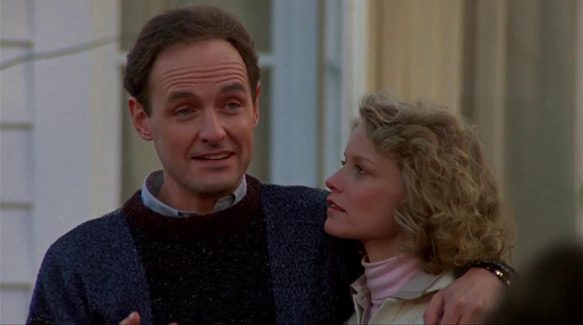
Joseph Ruben’s The Stepfather (1987) is a horror film that represents the longing for the perfect American Dream. Throughout the film, the audience sees Jerry Blake obsess over having the perfect life. He longs to have a perfect family, perfect job, perfect house and a perfect life. In the scene of the backyard party, the audience sees Jerry’s obsession with living the perfect American Dream. At this party Jerry says, “What I sell is the American Dream”. With each family Jerry has, he holds a Polaroid picture of them smiling together like the perfect family would. These photos hang from his work space in the basement of his various houses for Jerry to be reminded of what he wanted his perfect family to be like. Once something upsets the balance of his perfect family, Jerry turns angry and violent thus resulting in a killing spree. At the beginning of the film, Jerry’s new stepdaughter, Stephanie, dislikes him very much while Jerry wants nothing more for the whole family to mesh together. After her therapist is killed and Stephanie is comforted by Jerry, she begins to warm up to him and in a way submits to him. In Williams’ article he says “The films all make clear that the submission to any form of family authority results in a death”. This quote demonstrates that as soon as Stephanie finally accepted Jerry as her stepfather, she in a way sealed her fate of being on the unfortunate end of Jerry’s murderous outbreak.

Source: ITC Productions

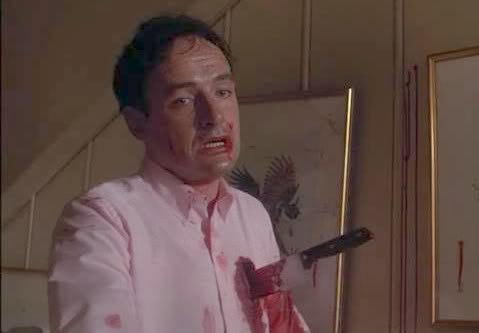
Throughout most horror films, the audience sees the aspect of the Final Girl (Williams’ article). Normally, there is one girl left after all her friends or family have been killed but in this film, the “final girl” turns into “final girls” due to the fact that the mother and daughter are both key parts of putting an end to the terror Jerry had inflicted upon their family. Once Jerry falls into a full-fledged maniac trying to kill his new family, Stephanie is quick to realize that she needs to escape and becomes resourceful and smart. Towards the conclusion of the film, Stephanie’s mother emerges from the basement, bleeding and injured, possessing the gun brought by Jerry’s previous wife’s brother. Expecting Jerry to harm her daughter, Susan shoots him twice just before Stephanie is able to stab Jerry in the heart. This form of death by knife indicates a form of Jerry’s castration anxiety. His need to always be the head of a family and a father shows his insecurity as a man and his lust for power in the home.

Source: ITC Productions

The audience also sees the concept of the male gaze in the film. As Jerry strolls down the street, he watches a family of three, longing for a family like theirs. Jerry thinks of a family as an object to be possessed and feels he is not complete without one. The moment he returned home is when the horror truly began.

Throughout the film, Jerry refers to his childhood and all the obstacles he had to overcome. In Williams’ article he says, “The monstrous adult child is product of a traumatic family situation” which means that a person’s upbringing and what happened to them as a child can greatly influence the type of person they grow up to be. This part of a person’s life determines whether someone has the potential to grow in a normal healthy person or a psychotic serial killer. In this film, Jerry most likely came from an environment that led him to become a vicious family killer.

Blog Post 7- The Texas Chainsaw Massacre

The Summary:

In Tony Williams’s article, Chain Saw Massacres: The Apocalyptic Dimension, Williams defends the stalker and slasher films that are often considered worthless trash. These types of films were the product of a cultural movement that started in the 70’s and erupted into the 80’s. Williams poses his views that “the full nihilistic apocalyptic vision emerges in the eighties” which is a counterargument to Christopher Sharrett’s view on the subject. Analogies are made between stalker and slasher films and historical and cultural events such as the views of the Puritans and the idea of the American Dream. Comparisons of the fears of the Puritans and the lifestyle of the murderous family are made in the article to suggest they are one in the same. Williams goes on to an in depth analysis on the film Texas Chainsaw Massacre which brings back ideas that the events in this film are inspired by the deepest fears of people in history. There are correlations between the good and evil characters to show ways they are similar. There is a section that piqued my interest about foreshadowing events. Williams addresses that the scene when the gang picks up Hitchhiker, the stories on the radio about different acts of violence are foreshadowing the coming events of the family violence. I interpreted that normally when you think of family, you think of love, compassion, and kindness but with this family of cannibals you get violent, grotesque monsters.

My analysis:

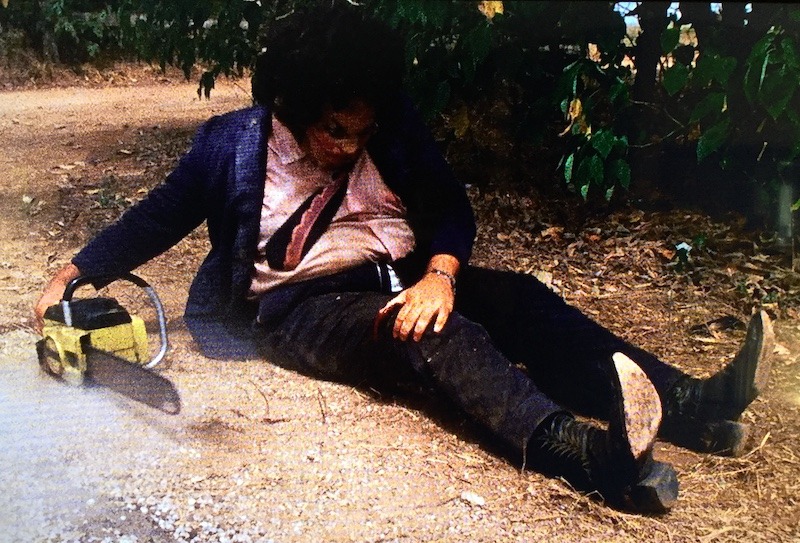
Tobe Hooper’s The Texas Chainsaw Massacre (1974) is a classic horror film that shows the disturbances and horror of a family of cannibals in Texas relating to the apocalyptic mood. Throughout the film, the audience sees a similarity between the two sets of siblings. The audience sees Sally care for her handicapable brother, Franklin just as the audience sees Hitchhiker look out for his brother Leatherface (Williams article). The audience sees child-like behavior out of both Franklin and Leatherface in two particular scenes. For Franklin, the audience sees a child-like temper tantrum when Sally and her friends are out exploring the old house while Franklin has to stay behind in his wheelchair. He spits and sticks out his tongue just as a jealous child would do. The audience sees the child-like tendencies in the scene where Jerry enters the “kill room”. Leatherface panics and whacks Jerry with the sledgehammer and then frantically runs away while making crying like sounds. Another example of Leatherface’s childish behavior is at the end of the film, as he ways his chainsaw in the air, watching Sally get away. He is throwing a temper tantrum just as Franklin had done earlier in the film. Leatherface is inaudible to his identification with the animals he has slaughtered and seems very unintelligent (Williams’s article). Like Jerry, the male characters are all killed very quickly and brutally whereas their female companion has a gruesome experience while still alive. After Pam is captured, she is hung from a hook like cattle while she watched Leatherface carve up Kirk. She is then stuffed in a freezer, still alive, to await her fate. This is a common theme seen in horror films, the male deaths are brief while the female’s pain is carried out for a while.

Source: Vortex Films

This family of cannibals in the film is a dark embodiment of the American dream in our history (Williams article). As technology emerges and begins to take over the meat/slaughter business, families with businesses of their own are pushed aside and can’t compete with the big corporations. In the van scene, just after the friends have picked up Hitchhiker, he talks about how killing an animal with the sledgehammer is the best way as opposed to the air gun recently created. In a way, this mirrors the situation that the cannibal family is going through, technology over the manual technique. Once their livelihood was compromised, the family of cannibals started killing and cooking travelers to sell to unexpecting customers for economic survival (Williams’s aritcle).

Another major thing in this film is the iconic use of weapons. Typically the serial killers in slasher and stalker films are very repressed. We see this trait in Leatherface. By using a chainsaw to murder and hack up him victims, this is a sexual release for him. Ironically, the only character killed by the chainsaw was Franklin. The use of this shows the fear of castration anxiety in Leatherface and he uses this weapon to show his dominance and strike fear into his victims. The audience sees at the end of the film when the chainsaw penetrates Leatherface’s leg and he in a way is castrated by the fact that Sally escaped her fate.

Source: Vortex Films

Blog Post 6 – Carrie

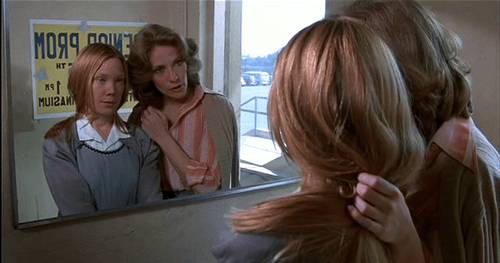
Brian De Palma’s Carrie (1976) is an excellent example of the monstrous feminine. Throughout the film, we see Carrie make the transformation from her childhood into womanhood with the arrival of her first period. With the said arrival offers the idea of the possibility of sexuality. In Shelly Stamp Lindsey’s article, she discusses how the feminine sexuality is made monstrous and horrific. Throughout her entire life, Mrs. White has drilled into Carrie that sexuality is a sin and she should never be sexual in any way. This includes what she looks like (hair, makeup, clothing) and who she interacts with. While in school, Carrie is encouraged by her gym teacher, Miss Collins, to put a little more effort into her appearance. She suggests makeup and maybe curling her hair to make a difference. With this suggestion, Carrie begins to masquerade her horrific side. She attempts to use the makeup and the different clothes to cover up her monstrous tendencies (Lindsey’s article).

Source : MGM

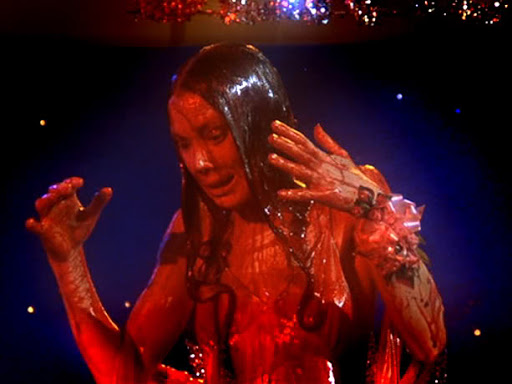
The audience sees the monstrous side of Carrie come to the surface at the extreme after she is crowned queen of the prom and has shared her first kiss with Tommy Ross. Her first kiss is her first sexual act ever and thus awakens the monster within. To quote Lindsey “Her inner monstrosity finally exposed for all to see, and ultimately unable to “plug it up”, Carrie becomes an outright monster” (page 340). In the opening scene when Carrie got her period and panicked, all the girls in the locker room shouted “Plug it up” while throwing tampons and pads at her. They say this as meaning to stop the blood flow. At the prom, as Carrie is drenched in the pigs blood, it signifies that she is unable to ‘plug’  her telekinetic powers or her monstrosity and thus torches all the prom guests (Lindsey’s article).

Source: MGM

The audience also see the monstrous feminine in Mrs. White. She has been sexually repressed her entire life and strongly believe sexual acts are a sin and if you engage in them you should be punished. She is aggressive with Carrie when she finds out Carrie has started menstruation and orders her to pray in hopes to repress this sexuality. The audience sees at the end of the film when she opens up to Carrie about her previous sexual acts and how she enjoyed them is when we Mrs. White becomes violence and stabs Carrie thus showing another example of how feminine sexuality is made monstrous. After being stabbed and killing her mother, we see Carrie telekinesis spiral and ultimately lead to her own demise. As she burns her house down and it slowly starts to sink into the ground, we see Carrie literally becoming one with the devil and thus reinforcing the idea that feminine sexuality is monstrous and horrific. 

Blog Post 5 – The Exorcist

William Freidkin’s The Exorcist (1972) is a great example of the monstrous feminine. Throughout the film we see the concept of abjection. As Reagan becomes possessed by the demon claiming to be “the devil himself”, he violates order in the McNeil’s lives (Creed’s article). To restore order, the demon must be expelled from her body through exorcism. At the beginning of the film, Reagan and her mother were extremely close. As the film goes on and Reagan becomes possessed, her behavior towards her mother becomes aggressive and violent. Chris tries to help Reagan in any way that she can but she only ends up agitating her more. In this way, Chris is becoming abject in Reagan’s life. As a child grows up and tries to break free of their mothers care and nurturing tendencies, the mother is reluctant to to release the child (Creed’s article). As Chris tries to help Reagan, she is reluctant to step back and listen to the doctors about what they think is wrong with Reagan. She tries time and time again to help Reagan even though her behavior is clear that she wants nothing to do with Chris. This demonstrates the maternal figure as abject.

Source : Warner Brothers Pictures

Throughout the film, we see a woman aligned with the devil and how the foul and monstrous woman is represented (Creed’s article). As Reagan is possessed her behavior and language is controlled by the demon (who happens to be male), but is still in the body of a twelve year old girl. The foulness and monstrous aspect is shown through her physical appearance and her behavior. The demon takes more and more control, Reagan loses her control over the various bodily functions. Her body quickly becomes a canvas for vomit, scratches, blood, urine, and excrement (multiple different forms of abject).

Source: Warner Brothers Pictures

The monstrous side is shown through her behavior and language. She uses vulgar language excessively and makes noises that almost sound like a beast. For example, she constantly growls and does other beast-like actions such as accessing a superhuman-like strength. Reagan’s body is slashed and mutilated to the point where she almost resembles a zombie type form. This disfigurement can signify a castrated state for Reagan herself, but also the possibility of castration for the man that is controlling her from the inside (Creed’s article). This film is a great example of abjection and the monstrous and foul feminine and very closely relates to Barbara Creed’s article “Horror and the Monstrous-Feminine: An Imaginary Abjection”.

Blog Post 4 – Scream

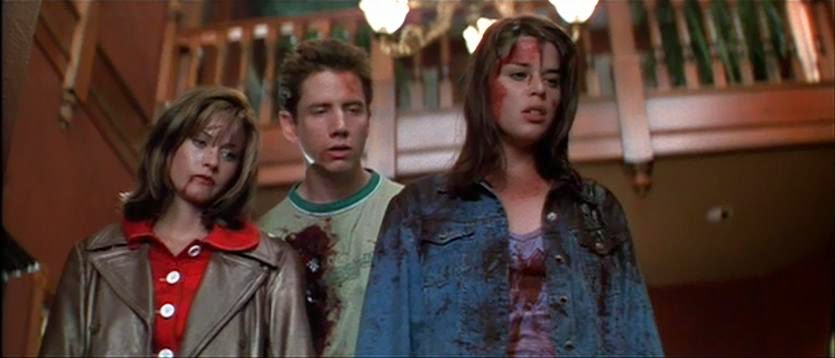
Wes Craven’s Scream (1996) is a great example of a postmodern slasher film. In the film, there are many slasher film elements seen. The final girl is clearly laid out from the beginning of the film. The audience sees Sidney Prescott as the boyish and very reserved virgin and as the character that seems to be the killer’s main focus. The audience also sees the terrible place in Stu Macher’s isolated home where most of the killing occurs. The weapon chosen is also very symbolic. Using a knife to murder is a very personal weapon and allows the killers to physically penetrate their victims (Clover’s article). Revenge is clearly the motive for the murders as the audience discovers later in the film when Billy reveals he raped and murdered Sydney’s mother because she had an affair with his father and broke up his parents’ marriage. It can be assumed that Stu murdered Casey out of vengeance after their breakup. This reveals that Billy and Stu are extremely disturbed both emotionally and sexually.

Source: Dimension Films

The audience also sees Sidney become phallicized as she becomes more masculine throughout the film (Clover’s article). Although not starting as the stereotypical feminine character, the audience sees Sidney become much more masculine as she defends herself against two killers. Sidney even becomes resourceful throughout the film, as a typical final girl does (Clover’s article), when she uses items in the house to try and aid her escape (i.e. using the door to stop another door from opening, the surfboard, the tv, etc.) When Sidney is victorious in the end, she is stripping the killers of their power and masculinity (castration). This shows when she finally kills Billy while wearing the Ghostface costume as she becomes what she feared the most the entire film and protects herself and her father.

Source: Dimension Films


A postmodern element seen the entire film is meta in nature. In the whole film there are references to horror movies. There is a scene when Sidney is on the phone with who she believes is Randy and she says that in a typical horror movie the girl runs up the stairs instead of out the door and that it’s insulting. Seconds after, Sidney is attacked and she does just what she deemed insulting. Later in the film, Randy discusses the “rules” of a horror movie. He talks about if you have sex, do drugs or drink , or say “I’ll be right back” you are typically a character that gets killed whereas the virgin always outsmarts the villain in the end. As Billy, Sidney and Stu stand in the kitchen and the boys are explaining their entire plan they say “Now that you’ve had sex you are supposed to die. Those are the rules”. Especially right before Sidney kills Billy she says “not in my movie”. Even though she is actually in a movie, she is referring to her reality. In many ways Scream mirrors the postmodern slasher films that Clover discusses in her article.

Blog Post 3 – Halloween

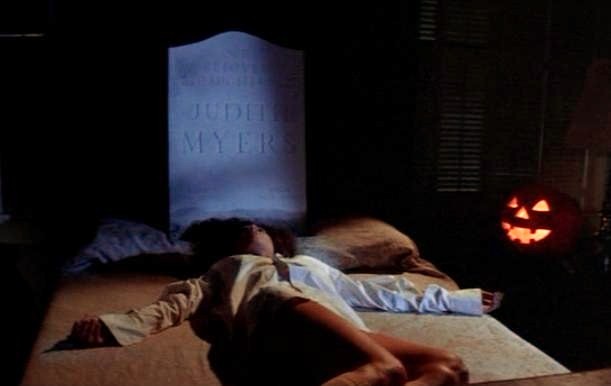
John Carpenter’s Halloween (1978) is a postmodern film that highlights the different components of the slasher films (killer, locale, weapons, victims, and shock effects) which are discussed in detail in Carol Clover’s “Her Body, Himself: Gender in the Slasher Film”. The opening scene of the film shows Judith Meyers and her boyfriend engaging in sexual activity while 6 year old Micheal observes from outside. As a result of Micheal seeing, he stabs her multiple times with a large kitchen knife as she sits in front of her mirror, naked. The weapon he chooses allows him to physically put something into his sister which makes the kill much more personal. 

Compass International Pictures

Micheal Meyers is an extremely emotionally disturbed man. After he escapes from the asylum, Micheal heads to his hometown to stalk and kill a group of friends on Halloween night. Laurie, who is very feminine, innocent, quiet, and smart, Annie, who is wild and unchaste, and Lynda who is the stereotypical sexually active cheerleader are our main characters in the film. The audience can tell from the very beginning that Laurie is the final girl. The Final Girl in a slasher film is typically very innocent and is usually the one to find her friend’s mutilated bodies as well as endure an agonizing chase with the killer (Clover’s article, page 84-85). She also has a sense that something is wrong which is a recurring theme in the film. Laurie is convinced there is someone following and watching her, while her friends completely ignore the possible danger. We also see Laurie’s transformation from a very feminine, timid character in the beginning to a more masculine and brave character in the end (Clover’s article).

Compass International Pictures

As Micheal stalks and kills his victims, he does so while wearing a mask. There is a scene when he is strangling Laurie and she rips his mask off. He stops attacking her to put the mask back on. It is almost as if he needs a mask in order to kill (he had a mask on when he killed his sister as well). It is likely that Micheal is locked in a child state of mind (Clover’s article, page 77) and feels as though if he wears the mask, it will be like killing his sister all over again. This, and the fact that Micheal displayed Annie, the girl who physically resembled Judith, in front of her stole tombstone after he killed her shows that all the girls he kills are just surrogates for his sister. He wants to recreate the feeling he experienced during his first murder. We also see that the murders of all the girls are played out and are very up close, where as Bob was murdered quickly because he was in the way of Micheal’s real target, the girls. The audience also sees the postmodern element of an open ending, leaving the audience without answers. Halloween contains many of the elements talked about in Clover’s article and is therefore a great example of a postmodern slasher film.

Blog Post 2-Psycho

Universal Pictures
Universal Pictures

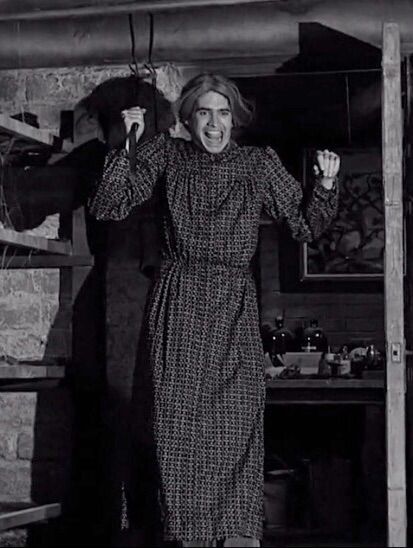
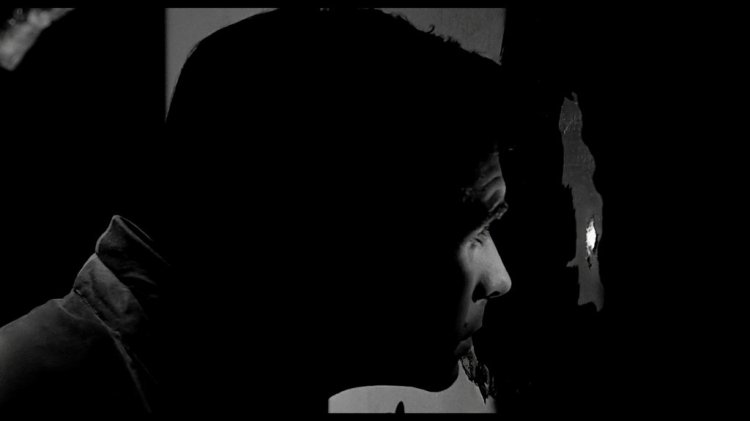
Alfred Hitchcock’s Psycho (1960) is an excellent example of the male gaze concept. The male gaze concept states that women in film are used for visual pleasure and are presented as sexual objects for male pleasure. Throughout the film, we see this concept quite literally as Norman Bates watches Marion Crane from the peephole looking into her room from his office. In this particular scene, we see Marion through Norman’s eyes and it shows the audience that she is being watched (discussed in Mulvey’s article). As Norman watches Marion, he becomes sexually aroused by her which ultimately drives him to murder. Marion is punished for her sexuality although she did not encourage Norman in any way. This idea is mentioned in Linda William’s article as she discusses the characteristics of a psychopathic horror film.

Another way the male gaze is shown in Psycho is through the relationship with Norman and his mother. Females are primarily seen as a sexual object and that is exactly what Mrs. Bates is to Norman (literally an object that he can manipulate/move, dress and most importantly look at). After her death, Norman stole her corpse and set it up in his house to make it feel like his mother was still alive. Norman will talk for her and carry on conversations with himself which evidently led to half of his personality morphing into his mother’s. Now, whenever Norman is sexually aroused by a woman, this mother half comes to the surface in a rage and is driven to kill these women. This is symbolic because it represents a form of castration anxiety. Although Norman does not physically lose his penis, he loses his masculinity when he becomes his mother. She takes control and is the dominant half to the point where Norman even dresses and speaks like her (long dress and a wig). When Norman becomes his mother and stabs these women, the knife serves as a symbolic penis penetrating the women since Norman does not have sex with them.

The concept of voyeurism, discussed in Mulvey’s article, is also seen in the film. As Norman watches Marion undress and prepare to take a shower, he becomes aroused by nothing but the sight of her undressing and her partially naked body. By showing Marion through Norman’s eyes it is also meant for the pleasure of the male audience members as well as the male character in the film. When Marion arrives at the motel and is invited to have dinner with Norman, she suggests they eat inside her motel room. Norman’s hesitation shows how he is scared/intimidated by the bedroom and sex and this reinforces the idea that he prefers to watch. All the actions of Norman/Mrs. Bates demonstrates his sadistic, voyeuristic, and psychotic tendencies and relates well to the concept of the male gaze.

Design a site like this with WordPress.com
Get started