Summary:
In Robin R. Means Coleman’s article “Studying Blacks and Horror Films” Coleman discusses the difference between “Blacks in Horror Films” and “Black Horror Films” as well as horror as a genre. Coleman discusses a book by Isabel Pinedo and how she defines the horror genre. According to Pinedo there are five key descriptors: (1) horror disrupts the everyday world; (2) it transgresses and violates boundaries; (3) it upsets the validity of rationality; (4) it resists narrative closure; (5) it works to evoke fear. Another characteristic of the horror genre is that they are normally very complex. “Blacks in horror” films present Blacks/Blackness in the context of horror and understanding how Blackness is represented. The “racial other” is also incorporated into these films. “Black Horror films”, on the other hand, present Black experiences and cultural traditions. It is said that “black horror films” generally have a black writer, producer, director, actors because these people are able to better reach the black audiences and relate to their lives. Depending on the film, the black characters could be there to solely become a victim, others create a character and some are portrayed as horrific, monstrous killers. In the section titled, “A Century of Black Horror” the author discusses the evolution of Black Horror from before the 1930’s until the 2000’s. Black horror has gone from comedy shorts for the amusement of the non-black audiences to films inspired by hip-hop culture and that present a spatial allegiance to “the hood” just as the “black horror” films in the 1990’s.
Analysis:
Bernard Rose’s Candyman (1992) is a film that presents ideas that black characters can be the thing that horrifies and the victim that is horrified. Throughout the film, the audience sees the black characters as both the victims of terror and the terrorizer (Coleman’s article), but the audience also sees a horrifier as a young white woman, Helen. Anne-marie is a single mother that lives in Cabrini-green and she is “terrified of what could happen” after hearing Ruthie Jean screaming as she was being attacked by the Candyman. One could argue that the Candyman himself is a character that is horrified and a horrifier all in one. When the Candyman was alive, he fell in love with a young white woman. He had impregnated her and the girl’s father ordered him to be killed. In the moments leading up to his death, he was terrified. These acts of horror that were performed on him led him to become the thing that horrifies.
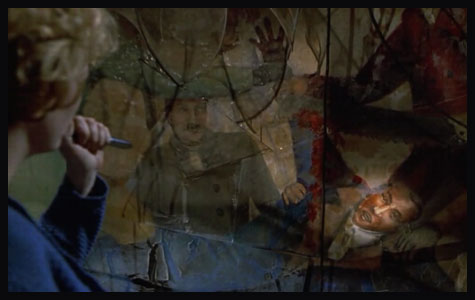
The audience also sees the concept of the racial other in this film. In this film, the Candyman would be considered as racial other (Coleman’s article). As the son of a slave, the Candyman was born into the class of those not seen as people but as property. As he grew up and his father made an important discovery, the Candyman was fortunate enough to be brought up properly and in an upper class home. Once grown, he discovered his love for painting. When he was asked to capture the virginal beauty of a white man’s daughter, he did so while he and the daughter fell in love. Although this relationship was two-sided, the father felt his daughter had been taken advantage of solely because the Candyman is black. This shows that although the Candyman had grown up with privilege and opportunities, the same as the white daughter, the father could not look past his skin color. This is a prime example of how the Candyman (a black man) is compared to his white counterparts and is seen as inferior.
The audience also can see the parallel between the Candyman and a demon. In Coleman’s article she says Blacks can be rendered as “a metaphor and catalyst for evil, and demonized, even though not always cast, physically, in the role of a demon.” Just as demons, the Candyman can be summoned and is seen as an extremely evil figure.
The audience also sees the concept of racial profiling and white privilege in this film. As the film shifts from the nice, clean and light area that houses primarily white residents to the dark, dirty, and dangerous Cabrini-green. The audience sees the Candyman mainly terrorizing the people of Cabrini-green. This suggests that danger, violence and evil is primarily coming from the black residential area which parallels to racial profiling and racism.
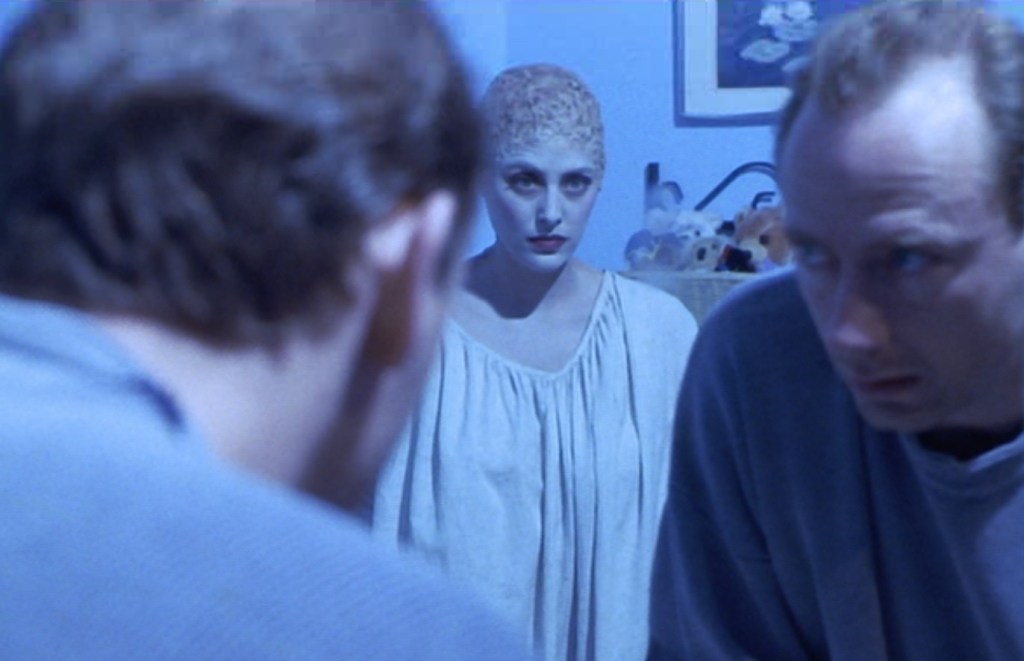
At the conclusion of the film, Helen’s husband, Trevor, is butchered by Helen in their home after he called her name five times and turned out the light. The idea that Helen has taken Candyman’s place horrifying people suggests that violence can happen anywhere and be committed by anyone, not just black people in black communities.
 CMS 353 Blogs