Summary:
In Tony Williams’s article Trying to Survive on the Darker Side: 1980s Family Horror, Williams provides a critique of Carol Clover’s depiction of women in horror films. Clover argues against categorizing slasher films as films that display male voyeurism towards the female body. Before analyzing Clover’s view on the feminine in the horror film, Williams’ addresses the use of special effects. The rise of special effects began in the 1970’s and only grew and was more prevalent in the 1980’s horror films. Williams’ argues that females in 1980’s horror films are alive, yes, but victorious, no. For example, Friday the 13th, Part III, the Final girl is taken away, calling in agony for her boyfriend in a nonindependent way that does not support the idea that she was victorious. This is a break of the rigid mold that Clover has put in the “Final Girl” into. Williams’ moves into the role of dysfunctional families in horror films. Versions of Friday the 13th, Halloween, and Nightmare on Elm Street show the role of dysfunctional families. In horror films, we need to consider the social origins of the monsters behind the mask. The stalker/slasher is frequently a product of a dysfunctional family. Post-1986 films start to emphasize the role of social interaction in the creation of serial killers. These types of people have issues with authority or parental figures. The films targeting this form of horror make it clear that “submission to any form of family authority results in death”. This idea is seen throughout the Nightmare on Elm Street series as Freddy takes on the role of children’s parents and then kills them. This article demonstrates the evolution of the “Final Girl” mold and the role of dysfunctional family horror in films.
Film Analysis:
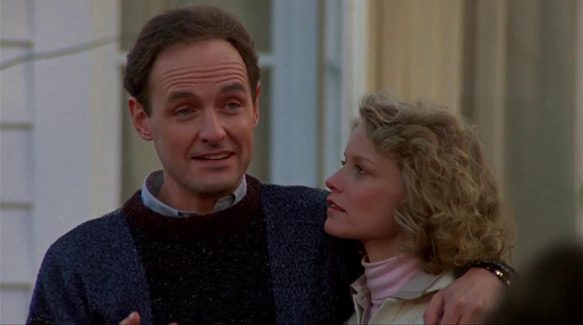
Joseph Ruben’s The Stepfather (1987) is a horror film that represents the longing for the perfect American Dream. Throughout the film, the audience sees Jerry Blake obsess over having the perfect life. He longs to have a perfect family, perfect job, perfect house and a perfect life. In the scene of the backyard party, the audience sees Jerry’s obsession with living the perfect American Dream. At this party Jerry says, “What I sell is the American Dream”. With each family Jerry has, he holds a Polaroid picture of them smiling together like the perfect family would. These photos hang from his work space in the basement of his various houses for Jerry to be reminded of what he wanted his perfect family to be like. Once something upsets the balance of his perfect family, Jerry turns angry and violent thus resulting in a killing spree. At the beginning of the film, Jerry’s new stepdaughter, Stephanie, dislikes him very much while Jerry wants nothing more for the whole family to mesh together. After her therapist is killed and Stephanie is comforted by Jerry, she begins to warm up to him and in a way submits to him. In Williams’ article he says “The films all make clear that the submission to any form of family authority results in a death”. This quote demonstrates that as soon as Stephanie finally accepted Jerry as her stepfather, she in a way sealed her fate of being on the unfortunate end of Jerry’s murderous outbreak.
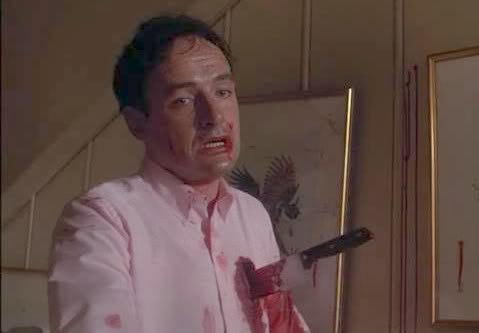
Throughout most horror films, the audience sees the aspect of the Final Girl (Williams’ article). Normally, there is one girl left after all her friends or family have been killed but in this film, the “final girl” turns into “final girls” due to the fact that the mother and daughter are both key parts of putting an end to the terror Jerry had inflicted upon their family. Once Jerry falls into a full-fledged maniac trying to kill his new family, Stephanie is quick to realize that she needs to escape and becomes resourceful and smart. Towards the conclusion of the film, Stephanie’s mother emerges from the basement, bleeding and injured, possessing the gun brought by Jerry’s previous wife’s brother. Expecting Jerry to harm her daughter, Susan shoots him twice just before Stephanie is able to stab Jerry in the heart. This form of death by knife indicates a form of Jerry’s castration anxiety. His need to always be the head of a family and a father shows his insecurity as a man and his lust for power in the home.
The audience also sees the concept of the male gaze in the film. As Jerry strolls down the street, he watches a family of three, longing for a family like theirs. Jerry thinks of a family as an object to be possessed and feels he is not complete without one. The moment he returned home is when the horror truly began.
Throughout the film, Jerry refers to his childhood and all the obstacles he had to overcome. In Williams’ article he says, “The monstrous adult child is product of a traumatic family situation” which means that a person’s upbringing and what happened to them as a child can greatly influence the type of person they grow up to be. This part of a person’s life determines whether someone has the potential to grow in a normal healthy person or a psychotic serial killer. In this film, Jerry most likely came from an environment that led him to become a vicious family killer.
 CMS 353 Blogs